
Did Usage Dice & Clocks just Evolve?
The quintessential abstract tools for progression and spending.

There’s something that keeps happening in tabletop RPG design that I find genuinely exciting. Designers look at an existing mechanic, squint at it a little, and then iterate on it in a way that makes you go oh, that works more for me! Or, now it makes sense!
Today I want to trace two of those evolutionary threads:
the lineage connecting Black Hack’s usage die to MCDM’s Crows
Forged in the Dark’s clocks, ICRPG’s effort dice and timers to a game called Everspark.
I love design rabbit holes, and each of these designs is something I appreciate. Let’s dig in.
Depleting Resource Evolution
The Usage Die: Black Hack's Resource Elegance
The usage die, as I first really encountered it in the Black Hack, is a beautifully simple answer to a genuinely annoying bookkeeping problem:
how do you track consumable resources without counting individual arrows or rations?
Here’s how it works. Instead of writing “14 arrows” on your sheet, you have a usage die: Ud8. Whenever you use the resource (fire an arrow, eat a ration), you roll that die. If you roll anything other than a 1-2, nothing changes. Roll a 1-2, and the die steps down: d8 becomes d6, d6 becomes d4, d4 is gone. Resource depleted.
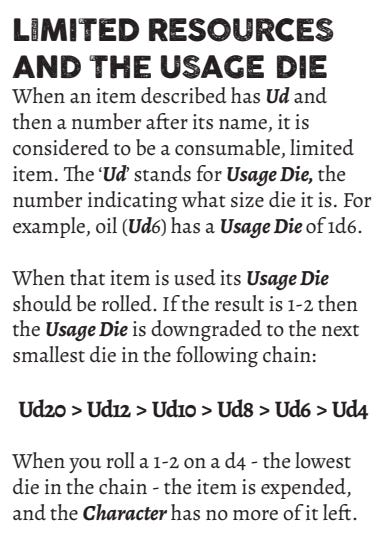
It’s elegant. It removes the bookkeeping. It introduces a satisfying tactile element. But, and this is just my critique, it’s wildly random. You might step down from a d8 to nothing in four unlucky rolls. You might hold onto that d12 for an entire campaign-arc! It’s hard for players to feel a meaningful sense of resource management when the outcome is so unpredictable. But! I will say, it always feels good when the player has to roll it. Very stressful. But it is also hard for the player to conceptualize how long the thing is going to last. Also, that could be what you want them to feel! Design matching setting, depending on your game.
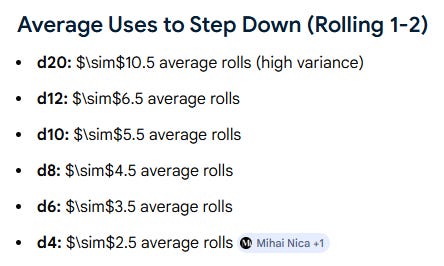
Let me point out that in some games the Usage Die step down on a 1, not a 1-2. So imagine how long you might have a d12 or a d10 if it only steps down initially on a 1
MCDM’s Crows: Flattening the Die, Keeping the Feel
MCDM recently previewed their game Crows, and one of the things they talked about was how they’re handling usage die, and it’s a lovely little evolution of the Black Hack’s idea.
Instead of a single die that steps down through denominations, Crows uses a pool of d6s. Let’s say you have arrows, this might be represented as 4d6s. When you fire an arrow, you roll ALL of those d6s. If any comes up 1 or 2, that die is gone. Not stepped down, just gone.
What does this change? Quite a bit, actually.
It removes the cascading randomness of the step-die system. You always know what you’re rolling, a d6. The question is just whether it survives. That creates a much more predictable rate of attrition. With a d6, you’ve got roughly a 1-in-3 chance of losing the die on any given roll. Now, rolling ALL of them will mess with your brain in terms of rate of ALL of them attritioning (just go with it).
What’s also cool is that you could very easily iterate on this design and say that you have Xd6, and you only roll one of them every time you use that item. So, that could slow down the rate, but the 33% chance of losing a die is still a simple to understand statistical model.
Progression Evolution
Clocks: Forged in the Dark’s Elegant Pressure Mechanic
If you haven’t played a Forged in the Dark game, (Blades in the Dark being the flagship) , clocks are one of the first things that will make you stop and appreciate what good game design looks like.
A clock is, at its simplest, a pie chart. A circle divided into anywhere from 4 to 10 slices. When something progresses, you fill in a slice. When the clock is full, the thing happens. That’s the whole mechanic.

But the elegance is in what that something can be. It’s completely up to the GM. Maybe filling in all 6 slices means the heist is complete. Maybe it means the rival gang has tracked you down. Maybe it means the bomb goes off. The clock is a neutral container for momentum/progress, and the GM decides what fills it. Is it time passing? Is it player failures? Is it successes? Is it reputation? Is it the whole encounter? Each answer creates a completely different kind of tension.
What clocks do brilliantly is make abstract progress visible. Players can see the clock. They know how close the thing is to happening. That transparency does a lot of narrative and emotional work at the table.
Effort and Timers: ICRPG Flattens Everything
Around the same time I was falling in love with clocks, I stumbled into ICRPG, Index Card RPG by Runehammer, and found a design philosophy that attacked the same problem from a completely different angle.
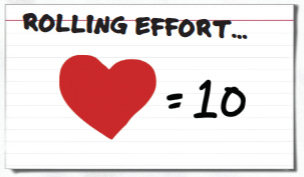
ICRPG’s big insight is this: everything is effort. Stabbing a monster, picking a lock, climbing a cliff, decoding a ritual, all of it gets measured the same way. In increments called hearts. Hearts represent 10 points of effort. You have a task? It has a heart (or more). You roll effort dice, which type depends on what you’re doing, and you chip away at it.
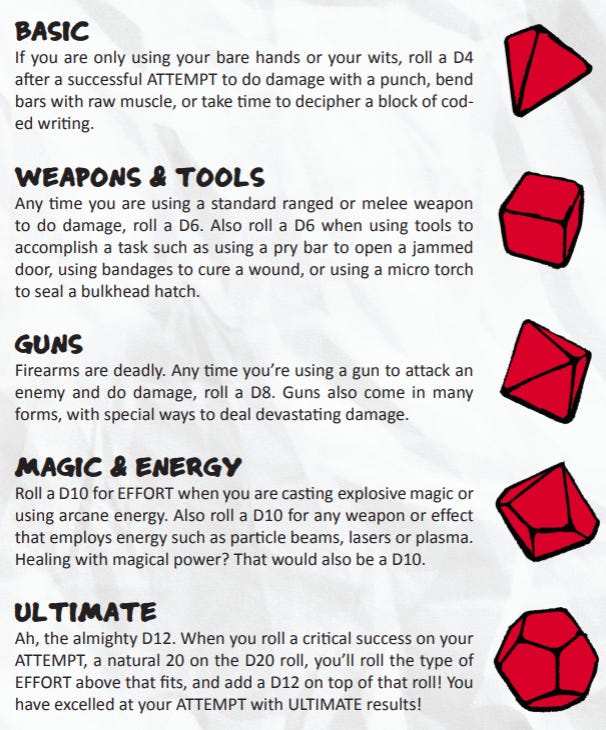
What I love about this is how it dissolves the old distinction between “combat” and “skill checks.” Previously, monsters were hit point bags and skill challenges were binary pass/fail moments (or maybe you’d say “three successes opens the lock”). ICRPG just says: no, it’s all the same. Roll your effort, see how much progress you make.
The other piece ICRPG adds that I think is underrated is the timer. Specifically, the philosophy that every single round matters. Instead of saying “it takes 3 successful skill checks to unlock that lock” by saying “it’s two hearts” you have an unknown element of time to deal with. Will I roll high and unlock this in 1 round? Will it take 3 rounds? That damn timer is going, and we can’t wait 3 rounds!!
ICRPG bakes urgency into its DNA in a way that makes every roll feel consequential. It rhymes with clocks, but it’s coming from a different design direction, less about GM-adjudicated progress, more about a constant ticking rhythm built into every scene.
Sparks: Everspark's Wildly Clever Synthesis
I saved Sparks for last on purpose, because it's genuinely both things we've been talking about this whole post. It works as a progress clock, and it works as a usage die. Same mechanic with two potential jobs. The fact that the designer has openly cited Blades in the Dark and the Black Hack as his influences makes the whole lineage click into place. Sparks aren't a departure from those ideas, they're a love letter to them.
Okay. So here’s where things get genuinely exciting.
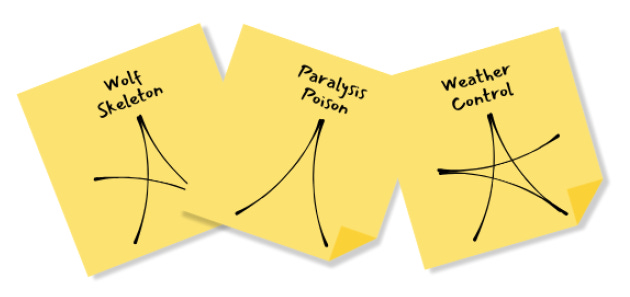
A game called Everspark, by designer Cesar Capacle, has a mechanic called Sparks, and once you understand it, you start to see it as a kind of synthesis of everything we’ve talked about above: the visual progress of a clock, the tactile resource management of a usage die, and the narrative urgency of ICRPG’s timers, all wrapped up in one deceptively simple package.
Here’s the core idea: a Spark is a five-pointed star that you physically draw, one line at a time (he prefers on a sticky note). Each line is called a Ray.
You label the sticky note with whatever dramatic element you’re tracking: “The Temple Collapses,” “Pack of Rustrats,” “The Collapsing Bridge”. You place it on the table in front of you. As the story (or the dice) demand it, you add a ray.
These rays fulfill the roll of the Progress Clock. You are physically creating them, and you can see it moving forward. Either towards something good or bad.
After adding a ray, you roll a d6 (called a check). If you hit the ray, meaning you roll equal to or under the number of rays currently drawn, the Spark resolves. Whatever it was tracking immediately happens. The temple falls, the pack scatters, ot the bridge gives way.
I want to point out that you don’t always roll a d6 when you add a ray. Each Spark is variable. See NACHO design concepts below. Otherwise, that’s the whole mechanic. But the design space it opens up is really fun!
The first thing that struck me is how cleverly it handles the randomness problem that the usage die has always struggled with. With Sparks, you always know where you stand, you can see exactly how many rays are drawn. And crucially, the probability of resolution scales with progress. One ray means a 1-in-6 chance of triggering. Three rays means a 3-in-6 chance. By the time you’ve drawn all five, you’re almost certain it’s happening, but you never know exactly when. It’s “controlled unpredictability,” as the designer calls it, and that phrase nails it. The suspense is real, but it’s not arbitrary.
I gave the examples for moments that the author teaches with above, but it can be lots of things:
The second thing that struck me is what happens when you close the Spark. When you add that fifth and final ray without triggering a resolution. At that point, you make one last roll, but now there’s a twist: rolling a 6 causes an Overturn. The thing still happens, but it’s the opposite…it flips.
A negative event becomes positive, or a positive one turns negative. The temple collapses, but reveals a hidden tunnel. The ambush resolves, but the “defeated” enemy turns out to be an ally in disguise. It’s a built-in narrative surprise generator that rewards getting pushed to the edge.
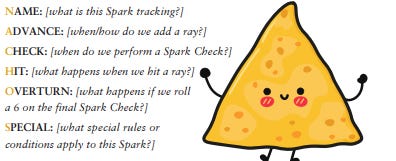
The designer even gives you a template called NACHOS: Name, Advance, Check, Hit, Overturn, Special, to define any Spark you create. It’s a lightweight but surprisingly complete design tool, and it keeps every Spark at the table clear and intentional rather than vague and hand-wavy.
What Everspark seems to have realized is that the clock and the usage die were both great mechanics that were solving a more fundamental problem:
how do you make progress and uncertainty feel dramatic, tactile, and visible at the table simultaneously?
Why I Love This
This is what I love about tabletop RPG design right now. The conversation is ongoing within designer’s work. Ideas build on each other. And somewhere out there, someone is squinting at one of your mechanics right now, thinking … what if we just…
Can’t wait to see what comes next.
-Jface
Sparks Sound super interesting. Going to have to check that out. Funnily enough today I read something about an underclock.
Start at 20. Each dungeon turn roll a d6 and substract. Pass zero trigger encounter. Hit zero exactly you turn to 3. On a 3 a shadow event that foreshadows something happens.
Resting resets all HP BUT increases d6 to d8. Meaning it becomes more dangerous.
I think the author changed it to roll6d6 and on 6 increase a 12 segment clock. Don't know why, I liked the original idea better because it scales better and less dice but still, I liked it
This is an awesome post and a useful one too.