
Getting your Resolution System Down

Outline
Flat vs Bell-curve
At Most & At Least rolls
Typical % chances
Ways to Alter Dice
Consequences & Story Elements
Other Interesting Mechanics
The Pressure System Mechanic
Resolution Systems
Let's delve into the fascinating concept of the Resolution System, which serves as the fundamental backbone of your TTRPG. It plays a crucial role in resolving all the actions taken by players, adding a touch of excitement and anticipation to the table. The beauty of a TTRPG lies in the unpredictable nature of what awaits next!
When designing a Resolution System for your game, there are various approaches to consider, but simplicity is key. Personally, I believe that if you opt for a die roll, the results should be easily interpreted, allowing the gameplay to flow smoothly and minimizing any potential downtime.
Now, an important aspect to grasp about resolution systems is the element of chance they bring. So, let's explore the first aspect in detail.
Flat Line vs Bell Curve
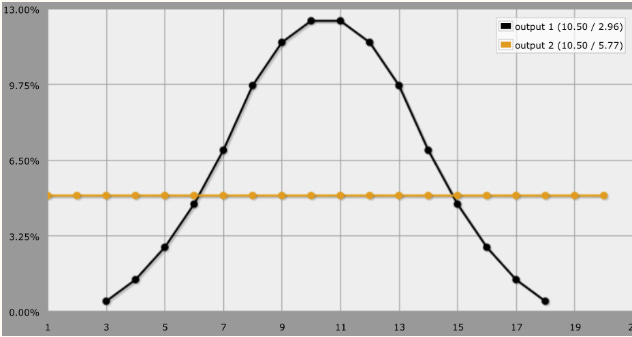
The images above showcase two types of outcomes that can be achieved with dice rolls: a flat line and a bell curve.
The flat gold line represents the results of a d20 game, where each number on the die has an equal probability of being rolled. For instance, when rolling a d20, there is a 5% chance of rolling any given number. This simplicity allows for a quick understanding of the odds. If there's a 5% chance for each number, it's easy to determine that the chances of rolling a number between 1 and 10 are 50%. It provides a clear and straightforward perspective.
The black curve is a bell curve. In this image, this is the result of rolling 3d6. This is actually what happens when you roll multiple dice of any kind. When you add those dice together you end up with a weighted region in the middle. When you play Craps with 2d6 the most likely result is 7. You have a weighted roll. This can also be very useful depending on what you are trying to accomplish.
Higher than or Lower than odds
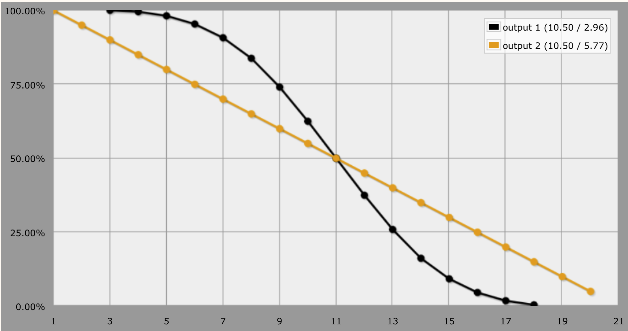
Another thing I like to consider when looking at resolution mechanics is the at least chances. Why? Most TTRPGs don’t have you just try to hit a specific target number like Craps. They are going to ask you to either roll over the number or roll under it. With the chart above we are asking the question “what are the chances I can roll a specific number or higher?”.
The d20 is going to have a flat line again running straight from 1 to 20. Each time you step to the right you are going to be decreasing your chances by 5%. If I wanted to roll a 16 or higher then I have a 25% chance to do it. Interestingly, rolling an 11 or higher presents a 50% chance, which aligns with the probability of a 3d6 dice roll.
Now, let's examine the scenario with 3d6. With three dice, the likelihood of rolling lower numbers is significantly higher. Rolling between 1 and 9 remains around 80% most of the time. However, as you aim for higher numbers, the difficulty increases. This explains why it can be challenging to obtain those coveted 18s when rolling for stats in classic D&D.
Is one method inherently superior to the other? Is a flat die roll better than a bell curve? The answer is no. It depends on your understanding of their purpose and how you utilize them. While not directly related to a resolution system, random monster encounter tables often employ 2d6. This allows them to place the most common monsters, such as goblins, in the 6-8 range, knowing that you're most likely to encounter them. They can then assign a dragon or lich to the 2 and 12 spots, as the odds of rolling those numbers are much lower. This showcases a clever way of using dice to enhance storytelling.
Ultimately, when using dice for a resolution system, the key factor to consider is how frequently you want players to succeed.
Typical % chances
There's an excellent video by Dungeon Craft that explores the evolution of D&D throughout the years. The key highlight of this video is the notion of the magic number: a 65% chance to hit. Having this 65% chance of success provides a sense of being an expert while maintaining a challenging gameplay experience. Let's examine the normal distribution spread:
65-70%: At this range, you possess expertise in your chosen area, showcasing your mastery.
45-60%: Falling within this range indicates a secondary skill level, where you're proficient but not yet an expert.
35-40%: When your chances lie here, it suggests a lack of skill or expertise in that particular domain.
By strategically implementing these probability ranges, the game creates a balance where players can feel accomplished as experts in their field while still facing formidable challenges.
On a D20 in D&D this looks like this:
7-8 or higher = 65-70%
9-12 or higher = 45-60%
13-14 or higher = 35-40%
Does this principle apply to other games as well? Absolutely! Let's take Dragonbane, for example. In this game, you are tasked with rolling under a target number using a d20. If your character possesses high skill and a formidable stat, resulting in a 14 skill rating, rolling a 14 or lower would roughly correspond to a 70% chance of success. This aligns with the concept we discussed earlier, where maintaining a sense of expertise is accompanied by a reasonable probability of achieving success.
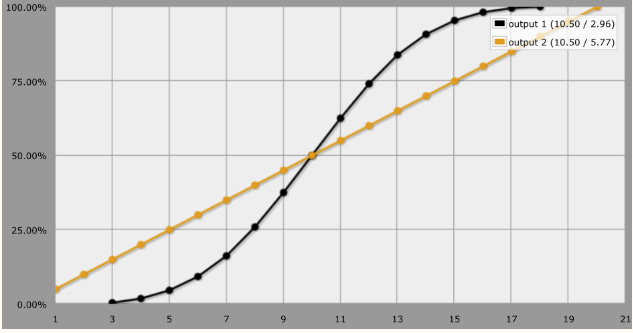
So, here's the thing for you as a game designer. When it comes to the rolling mechanics you decide to use in your game, whether you go for a flat line or a bell curve style, it's worth considering aiming for a success rate of around 65-70%. Why? Well, it seems like this range has become a sweet spot for achieving that satisfying feeling of success in modern gaming. By setting this target, you can create a balanced and enjoyable gameplay experience that keeps players engaged and motivated.
What about modifying the Dice?
There are two main conventions that get used a lot for modifying dice in games currently. You can do +'s and -'s, or you can do Advantage/Disadvantage (Bane/Boon).
Pluses and Minuses are simply having some sort of numeric plus or minus to whatever you roll. You get a +1 to your roll? Roll the dice and add 1 to the result. Simple. On a d20 this is easy math. It just means you are adding 5% to your success rate for each + you are giving out.
Advantage/Disadvantage or Bane/Boon is slightly different. With this you are going to roll your dice twice and either take the higher result (advantage) or take the lower result (disadvantage) of the two dice.
Roll a d20 with advantage means you roll 2-d20. If you get an 8 and a 13 you would keep the 13 result.
But whether you use one convention or the other its all just math.
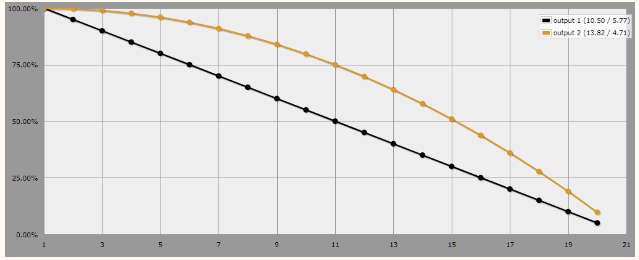
The Gold line in this image shows what happens when you have advantage with a d20. Most of the time this gets you a +15% chance. This means that having a +3 to an ability as a bonus is about the same as rolling with advantage. However, the feeling of rolling 2d20 vs getting a +3 might be completely different. That feeling is what you might be therefore designing for. Depending on the type of game you have.
To Be Continued….
In the next post, we'll delve into the topic of adding Context Dice to your resolution mechanics. We'll also explore various dice mechanics that are available, offering different options and possibilities. Additionally, we'll take a closer look at the intention behind the Pressure System mechanic and break it down for better understanding. Stay tuned for the upcoming post!