Board Game Design Checklist
I tried analyzing a game to get useful information out of it.

I’m building a board game. And somewhere in the middle of that process I ran into a problem. I know what my mechanics do. But I can’t make them feel good.
I can tell you the math, turn order, and the resource loop. But I can’t tell you why some games I love feel rich and alive, yet my prototype feels like doing paperwork.
So I went looking for a tool. Not a design philosophy, or book, but a checklist. I wanted something I could hold up against a turn of my game and go “yep, that’s there” or “oh. That’s not there at all.”
I couldn’t find one. So I ended up dissecting Heat: Pedal to the Metal. I’m not going to teach that game here (there are great videos for that) but I’ll explain enough as we go so that, hopefully, you won’t get lost.
The Checklist
Each item has two versions.
The designer question is what I’m asking as the person building the thing.
The player question is what the player is asking at the table, in their own head, in their own words.
Constraints: What limits make play predictable or legible?
What can I reasonably expect another player to do?
Planning: What can a player know with certainty they can accomplish right now? What outcome can I guarantee?
Risk: What can a player voluntarily trade certainty for, while still understanding the upside and downside?
How much uncertainty am I willing to accept?
Reading: What information lets players predict what others might be able to do, or plan to do?
What do I think everyone else is going to do?
Interaction: How do other players’ choices press on my choice?
How does their decision change mine?
Resolution: How does the play actually take place, and how much variability lives in it? Dice, cards, events, etc.
Was I right? What changed?
Consequence: How do choices create future problems or advantages?
What am I now stuck with because of what I just did?
Optionality: What’s the tension between acting now and staying flexible later?
Do I use this now or save it?
Recovery: What keeps mistakes or bad luck from becoming unrecoverable?
Can I still come back if this goes badly?
The Question
So now, moving forward, I can hopefully ask the following question for each one of these items on the Checklist
Where in my game does each experience come from?
I don’t need to reproduce this loop, but potentially this will ensure my mechanics are producing a similar experience.
Let’s Talk about Heat
Constraints
When I look at the Heat board, I know where my car is. I know where everyone else's car is. I can count spaces to the next corner. I know the speed limit of that corner. I can see what gear everyone is in, so I know their possible speeds. I can see how much Heat each player has left to spend.
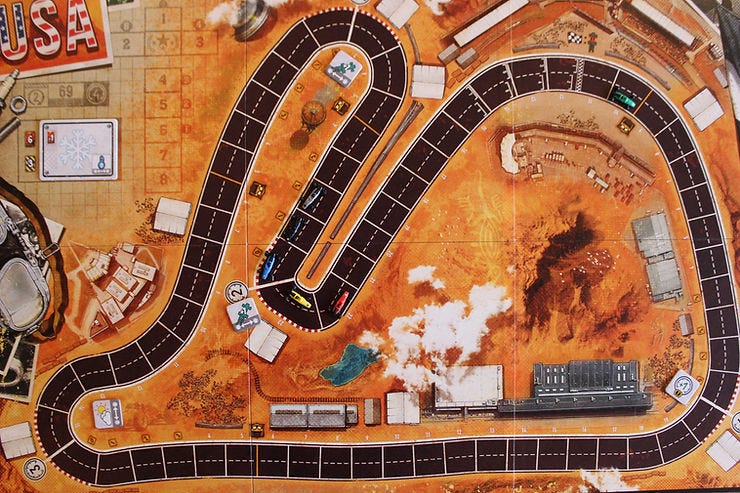
Combine all that with the cards in my hand and I know exactly how far I can go, and roughly how far anyone else can go. I can look at the track and know when they have to slow down, which tells me when I might be able to close the gap.
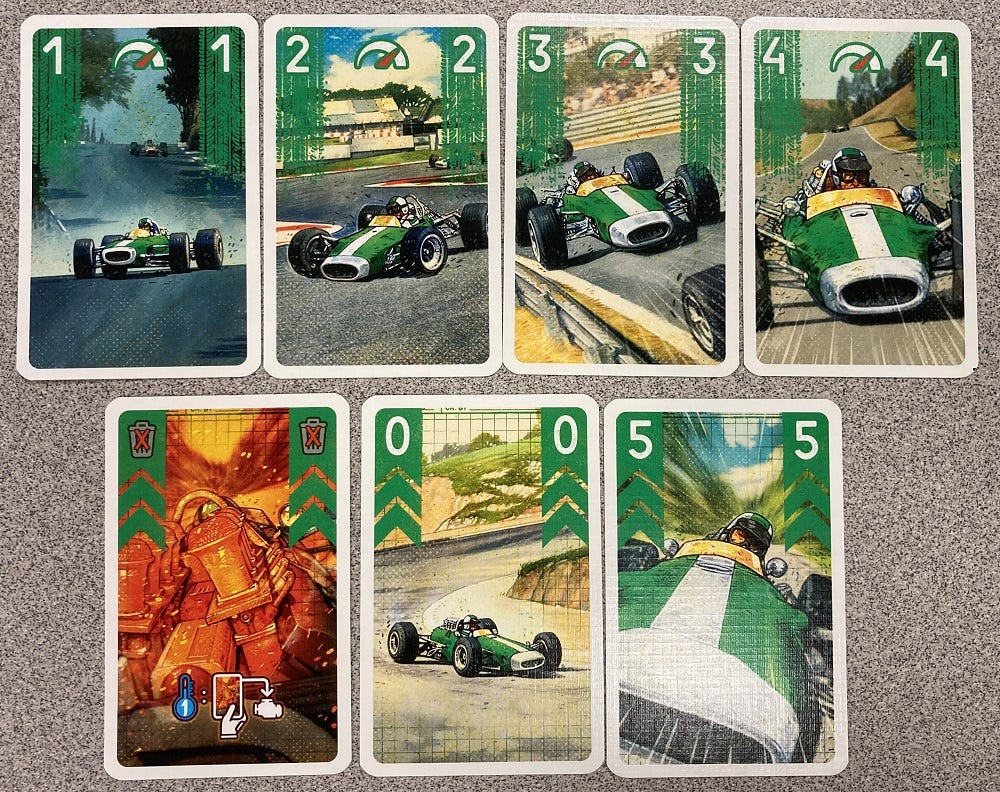
The math is dead simple and everything is glanceable. There's almost no cognitive load in understanding what I can do and what you can do.
That's the takeaway for me: your primary verb has to be intuitive, and the result of using it has to be visible.
Planning
Pick your gear, look at your seven cards, and you immediately know your capability. Distance is two things:
How many cards you play
the sum of their values
That is very simple math, since no card is bigger than 5 in value. So if you are in 2nd gear (can play 2 cards) you can very easily see that you can only travel X spaces.
Risk
But you can still do something unhinged. You can play a Stress card instead of a number. You can spend Heat to add a Stress on top of what you already played. Either way you flip the top card of your deck and add it to your total.
The lovely part is that this risk is calculable (calculatable?…umm you can guestimate it). You know your full deck. You know what’s in the discard. You have a real read on what’s coming. It’s uncertainty with a shape.
And if you’re a maniac, you can play four Stress cards as your whole hand and go anywhere from 5 to 15 spaces.…so yeah, there is some risk for the crazier players.
Reading
Reading only works because Constraints did their job. I see the corner’s speed, your gear, and your Heat. So I know whether you can take that corner fast or whether you’re about to slowdown.
Which tells me whether you’re setting up to Slipstream me, or whether I can Slipstream you. (Slipstream: free extra movement if you end close enough behind another car.)
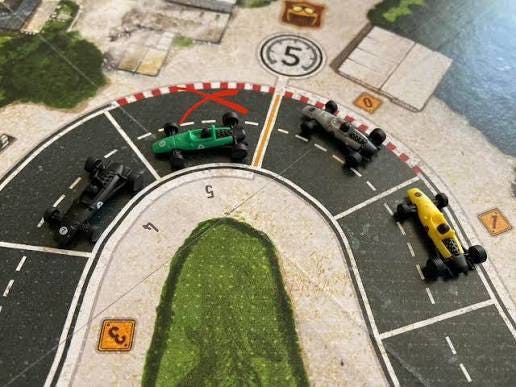
Predicting other people’s movement becomes a huge chunk of the game, and because of the beautiful Constraints it’s not 100% guesswork.
Interaction
This is the Slipstream. In a game where cards top out at 4 (occasionally 5), free movement is enormous. Getting far enough ahead that someone can’t draft you is going to make it very hard for them to catch up.
The monkey wrench is that Heat has simultaneous play. So you aren’t asking “how did their decision change mine?” as much as “based on what they might do, what should I do…because it matters”. Slightly different flavor of Interaction.
Resolution
Cars resolve in order, first place to last. And watching that happen is just plain fun. You see people close gaps. Cars catch perfect drafts. Missed plans leading to spin outs. Or that lunatic from earlier playing all Stress, and nobody at the table knows how far they’re about to go, including themselves.
It’s the moment at the table where things feel alive. It’s honestly like an autobattler in that moment. Everyone set the dials and then you see how things shape out.
Consequences
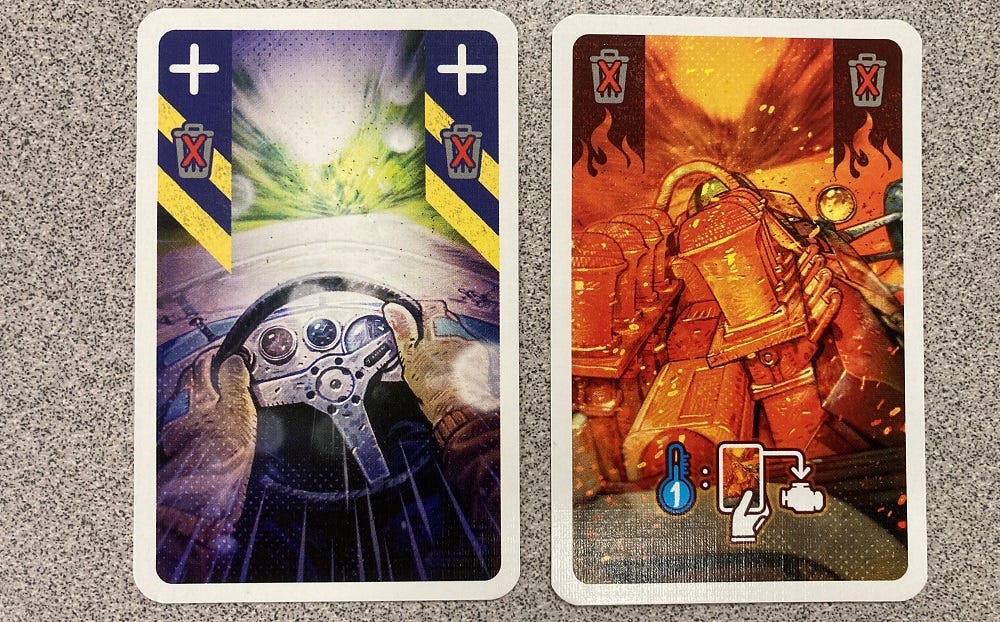
The Heat cards are how you push a bit harder. You can take a corner faster than the limit. You can add more speed on a straight a way. But you have to take Heat to do so.
Eventually that debt comes due, because Heat will clog your hand and you can’t get rid of it unless you slow down (go to a lower gear, causing you to play less cards). Now you’re holding a hand with maybe four playable cards, all of them high, and there’s a Speed 2 corner coming up…..now what?
That’s the game. Knowing when to push the car and knowing when you can afford to cool it. And if you back off to cool down, does the leader push just far enough out of reach and ride their burning car across the finish line? Do you push? So good.
Optionality
You don’t have to discard, even though you can. So you can bank cards for turns or straights you see coming. Do you hold that 4 speed through three corners waiting for the long straight? Do you hoard low cards or spend them now? And if you hold everything and draw Heat instead…do you have to play them now? Did you just cook yourself?
The hand management here is wonderful, because it decays. Your deck starts predictable and gets bloated with Heat until it isn’t predictable anymore.
So you start with clean Optionality…but as you add Risk that Optionality gets murky.
Recovery
Here’s where Heat is honestly not very forgiving. If you run too hot and spin out, you are probably out of the race. If the other player just gets around some sharp turns ahead of you…you might not recover.
There is a mechanic in the game that gives you a +1 every turn in movement when you are behind, but most of the time it doesn’t feel like enough. You just pushed too hard…it’s over. You’ve learned a lesson for your next race.
Design Lessons
To be honest I don’t have a lot of lessons yet, because I used this process of writing this blog to develop this checklist. So, now I have to go apply it to figure out if I have something useful or not.
What I can say is that I plan to use the player voice when I sit down to design next.
Instead of talking mechanics, I’ll be trying to play the game while saying these questions out loud
What can I expect from everyone else? What can I guarantee? How much uncertainty do I want? What do I think they'll do? Does that change my plan? …Was I right? What am I stuck with now? What did I save? Can I recover?
When I hit a “ummm…I don’t know” that’s when I’ll noodle around. Sidebar, I actually find myself recording videos as if talking to people, but then just never publishing them. Something about that helps get thoughts out for me.
I also need to link these things as much as I can. Constraints make Reading possible. Reading makes Interaction meaningful. Consequence becomes next turn's Planning problem. Optionality is just Planning arguing with Consequence about timing.
This just means that if something feels off, like Interaction…then it might actual be that my Constraints upstream aren’t clear enough yet.
Anywho. I hope everyone is enjoying their own game designs
-Jface
So glad to hear from you. Even more happy to hear you are making a boardgame! I'm in the process right now. To get the player's voices I try to set a prototype every month to my friends and I'm not telling them what I've changed or what I'm measuring. I show them a quick game rule (4 cards), tell them the goal of the scenario, I let them play (I don't play), I have a report sheet and most important I'm listening to all their remarks (recording and pesonal notes at the same time). Finally I ask them to fil a quick survey with 5-6 notes to judge (always the same topics). And then I make calculations to improve what's down. I use AI to help me in these tasks.
Do you think there are elements also useful to rpgs? It'd nice to have an extra insight also for this aspect! Thanks and may the fun be always at your table!