
Design Diary 2: Approach System

This article is HIGHLY referencing my last blog post. So you might want to catch up.
Before I could actually try this game out, I needed to answer some real design questions first. Some of these were actually supplied by Wrel, the creator of Distal, which I appreciated.
When I look at my character sheet at the start of my turn, what’s the primary thing I’m solving for?
In some games the question is mostly “what resource do I spend and at what target?” The drama is resource management and positioning.
In Forged in the Dark, the question is “how much risk am I willing to accept for how much effect?” The drama is the negotiation of stakes.
In a fighting game, the question is “what is my opponent about to do, and what beats it?” The drama is read and counter.
When I look at my sheet and choose my path, do I want that to feel more like plotting a route and weighing options, or more like committing to a style?
Can I describe what a player does on their turn in one or two sentences?
Good practice for any game design….
How do I keep Flaws, Limitations, Handicaps, and Strengths on a character sheet and make them actually matter without feeling like gimmicks? And do they have real player agency attached to them?
How does a character move from one node to another? Steps, turns, a small die roll?
What are the benefits of making these moves? Is there any? Am I gathering power as I move? Trying to create a compatible narrative sequence?
How do I stop people from always doing the optimal thing? Force them to move, don’t allow doubling back, reward longer distances?
A Turn in Play
To work through this I decided to just write out what a turn might actually look like in practice.
The Setup
The GM describes what just happened.
The Amalgam, a six-limbed construct of stolen flesh and copper wire, twisted sideways at the last second and Julian’s shot grazed wide. Julian is now exposed, his empty weapon visible. He’s in a bad position. The Amalgam is turning toward him.
It’s your turn.
Step 1: Your Narrative Intention
You hear the situation and something clicks. Julian is exposed because the Amalgam is fast and can apparently read ranged trajectories. You can’t out-aim it at range. It’ll dodge again. But if you close the distance and jam your Pulse Fist into its chassis?…maybe that’s a “dodge this” moment?
“I’m closing on it. I want to get inside its dodge. Put my fist against its chest and pull the trigger.”
That’s your intention declared. You know what you want narratively.
Step 2: GM Names the Requirements
The GM thinks about what that action actually demands and says:
“That’s a Forceful move. You’re still trying to land a precise shot, but you are definitely trying to ram that fist in there. So, Forceful approach and your still using Aim.”
Now you have a destination. Two circles you need to have touched in your web during your turn: through Forceful and ending on Aim.
Step 3: Reading Your Position
You look down at your sheet.
Your token is sitting on Careful. You spent last turn setting up a sightline, reading the Amalgam’s movement patterns. You learned a lot from that call then. But it’s the wrong position now.
You need to get to Forceful and then through it to Aim. Forceful is the body of the move. Aim is where it resolves.
You trace the potential paths:
Careful sits near Preparation and Resolve on your web. There’s a solid arrow from Careful toward Resolve, that’s a free move. But Resolve is nowhere near Forceful. To get from Resolve to Forceful you’d cross a dashed line with no arrow. Then you still need to reach Aim, which is one more hop from Forceful on a plain solid line. That’s an expensive trip and a weak die at the end of it.
You look at the other option. There’s a dotted line from Careful directly toward Forceful. Your condition written on it reads “when the situation is already lost.” Julian is exposed, his reload cycle is showing, and the Amalgam is turning toward him. That’s close enough. The dotted line is live. Free move to Forceful. From Forceful, Aim is one solid line hop.
The second path is better. One free move and the worst connection in the path is that solid line. And you end on Aim, which is exactly where you need to be to fire the Pulse Fist at contact range with any real accuracy behind it.
Step 4: Selecting a Card
You have a set of cards laid out to the side of your sheet. These represent the weapons, items, spells, abilities, and features available to you. Each one has one or more icons on them, linking them to your Realms, meaning you have to be on that Realm when to use it.
You have two cards linked to Aim:
Vibe Cannon. Range long to extreme. On significant impact the target cannot reposition next turn.
Pulse Fist. Range contact. On significant impact the target is staggered and their next action costs double.
non of these powers actually exist, I’m just writing cool stuff…
Both are available because you are ending your path on Aim. But the Pulse Fist is exactly what this moment is asking for. You are jamming yourself inside the Amalgam’s dodge window, barrel against chassis.
Step 5: Leaning into Character
You feel confident. You have been going with your strengths all game, threading through your best paths, landing clean. Which means now is exactly the right time to push. If you want your character to grow, you have to succeed while operating under your Flaws, Limitations, and Handicaps. That is how the advancement track moves.
You slide your Character Token from Motivation to Limitation, invoking it deliberately. Your Limitation reads:
I cannot place others at greater risk than myself.
The GM says the Amalgam is now targeting you instead of Julian. You drew its attention by stepping into that space. You take the normal Limitation penalty, and you become the Amalgam’s target.
The good news is that your advancement track ticks if you hit. You are operating inside your Limitation, which is exactly where growth lives in this game. Succeed here and you are one step closer to changing, resolving, or transforming that Limitation into something else entirely.
Step 6: The Roll
To be determined. The mechanics here are still being worked out.
Does this feel good?
Looking back at this I ask myself: is this overly complicated? Does it solve what I wanted it to?
Going back to those original questions, here is where I landed for this game.
What do I want to accomplish, and can I get there from here? - Intention as the primary decision, movement as the cost.
What is my opponent in, and what approach beats that state? - Reading the enemy as the primary decision, your movement as the answer.
Those are the two things I want players thinking about when they look at their sheet. Hopefully after they have already formed their narrative intention.
So I’ll be going with this so far.
Walking Through the Sheet
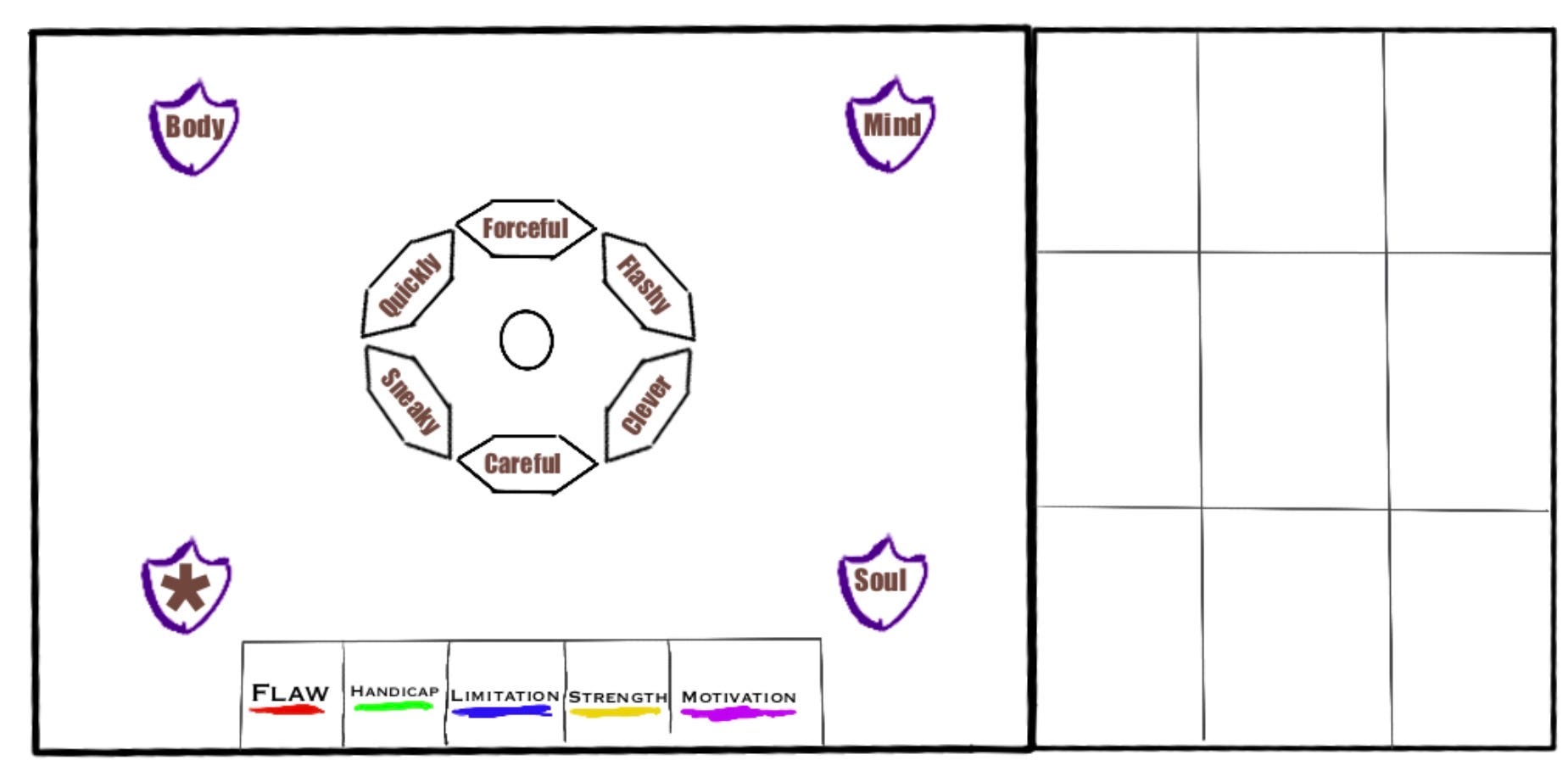
Approaches
Every action you take on your turn must pass through an Approach. No matter the path, no matter where you end up, you have to have touched an Approach first.
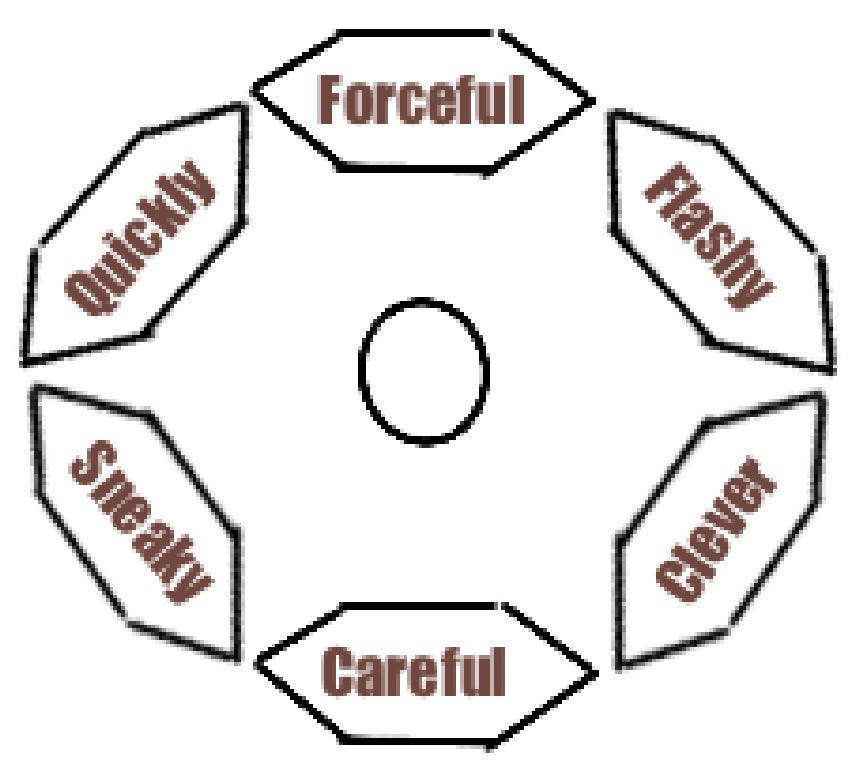
I was not originally a fan of Approaches in Fate Accelerated. I loved the concept but felt they fell short because players would just cheese the narrative to justify using whichever Approach had their highest bonus.
The good news here is that Approaches in this game have no stats. One is not numerically better than another for your character. But monsters will have vulnerabilities, resistances, and reactions tied to different Approaches, so they still carry real mechanical and narrative weight. Your character is not better or worse at a given Approach. But your web might be wired up better for some than others, and that is a meaningful distinction.
Defenses
The character sheet has four defense locations represented by shield icons. These shields sit outside the Approaches, positioned so that multiple Approaches can reach them naturally depending on how you build your web.
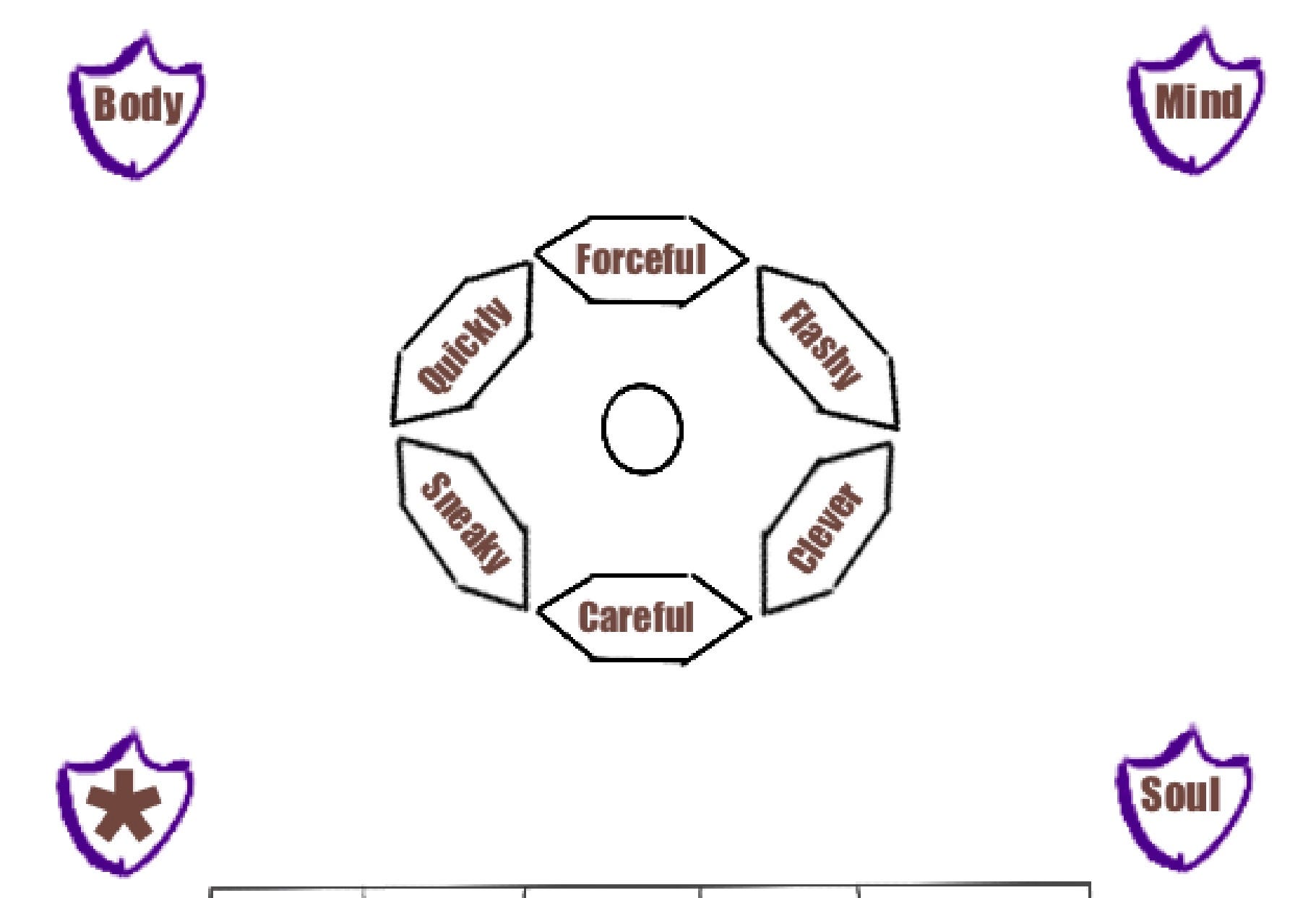
Three of the four Defenses are fixed. Body covers physical harm. Mind covers mental and psychological assault. Soul covers spiritual and divine attack.
The fourth defense is an asterisk, and it is a placeholder by design. This slot represents any special or situational Defense your character might carry at a given time. A shield that grants an active defense option. A spell like Mirror Image or Shield that you have prepared. A class feature, a temporary ward, something specific to your situation in this particular encounter.
The asterisk does not have a permanent identity because it should not. It changes. It reflects what you brought into this fight and what you have left. The asterisk reminds you that preparation matters.
When an attack comes in, you trace the path from your current token position to the relevant defense shield. How far you are from it and what connections exist between you and it determines how cleanly you can defend. When you defend your token is moved to the shield. If you choose not to defend, you’d leave your token alone. You might do this cause of what you want to do your next turn.
The Character Section
At the bottom of the character sheet sits a separate area with five locations. This section has its own token that rests on one of these locations at a time, completely independent of the token moving around your web above.
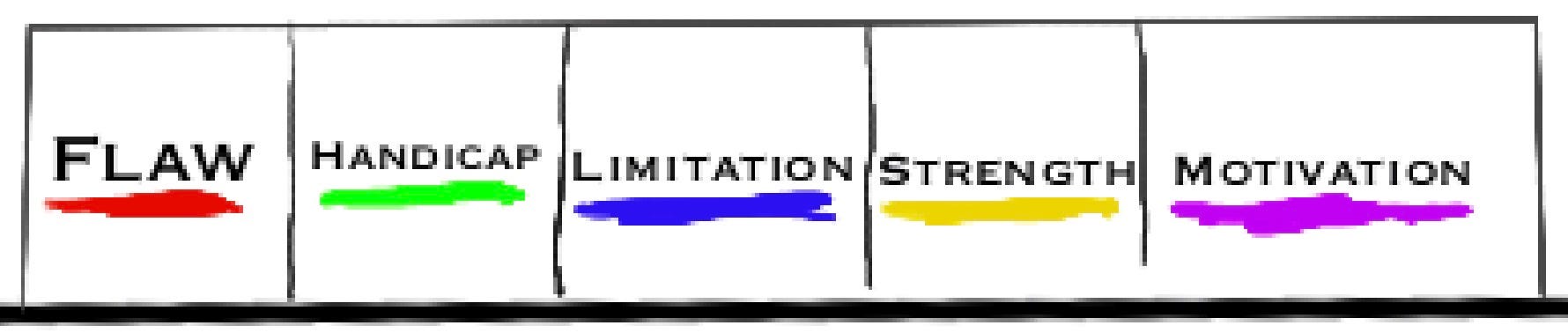
The five locations are Strength, Motivation, Flaw, Limitation, and Handicap.
At the start of your turn, before you act, you choose where this token sits. That is a deliberate choice. Are you leaning into your Strength, fighting from your best self? Are you driven by your Motivation, doing this because it means something to you? Or are you pushing into harder territory and operating under your Flaw, your Limitation, or your Handicap?
Each circle carries an effect, positive or negative, that modifies your action this turn.
Above these five circles is a progression track. A row of ticks This is how your character levels up.
Leveling in this game would not be based on monsters killed or gold collected. It would be based on doing difficult things that are specific to who your character is. The track only advances when you act while your token sits on Flaw, Limitation, or Handicap and you succeed anyway. Overcoming your own nature is what growth looks like here. Accumulate enough ticks and something changes. You improve, adapt, or transform that part of yourself into something new.
This is taken slightly from Forged in the Dark. In that system you have to roll a skill/attribute during a Desperate situation in order to progress it. Love that thematically!
A player who always rests on Strength will always perform well. But they will not grow. Growth requires operating in uncomfortable territory and proving that your character is more than their worst tendencies. That is the tension the system is built around.
Colored Paths
You may have noticed that each of the five locations at the bottom of the sheet carries a color. That color is functional, not decorative, and it connects directly to how your web operates.
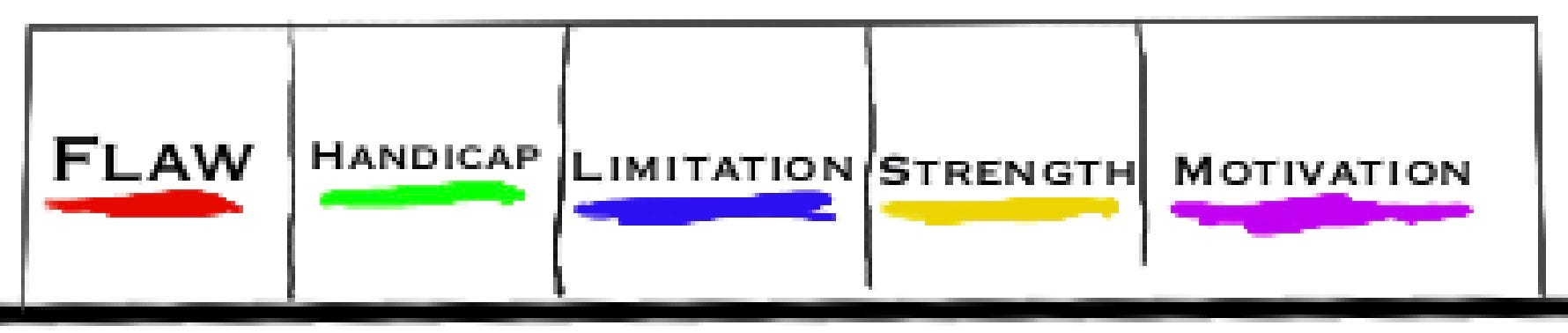
Standard lines on your web are black. Dotted, dashed, solid, with or without arrows, all drawn in black, all following the normal movement rules. But as you build and advance your character you gain the ability to add colored lines. These are special connections that only activate when your character token is sitting on the matching location at the bottom of the sheet.
Your Flaw circle is red. If you have drawn a red line from Forceful to Shield Brace, that path only exists when you are currently leaning into your Flaw. When your token is on Flaw, that red line is live. You can traverse it for free. When your token is anywhere else, that line does not exist as an option.
The result is that your sheet contains multiple webs layered on top of each other at the same time. The black web is always there. The colored webs flicker in and out depending on your current character state. A character operating from their Motivation has access to a different map than the same character operating from their Handicap.
Concepts / Realms / Something
This is the real meat and potatoes of the character sheet. It sits between the six approach wedges and everything else, and it is where your character’s identity actually lives mechanically.
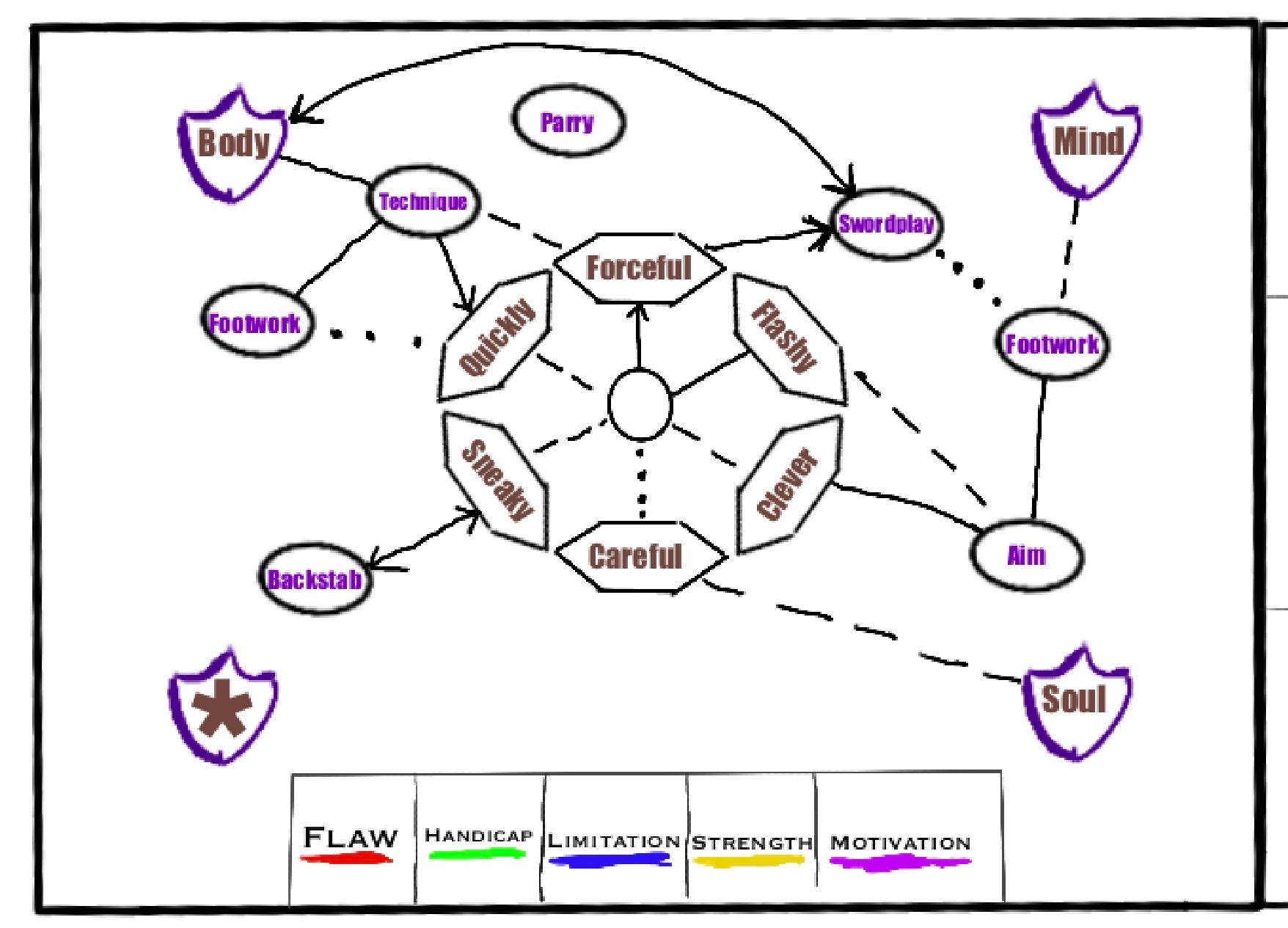
I do not have a final name for these yet. Realms? Concepts? Trainings? Disciplines? Nothing has locked in. But the idea is clear. These are the large meaningful buckets that describe what kind of fighter, mage, or operative your character is. Not broad archetypes like Fighter or Wizard, but the components that make those archetypes: Swordplay, Technique, Footwork, Weave, Divine Channeling, Opportunism. Specific enough to mean something, but broad enough to anchor multiple abilities beneath them.
These become the circles you place on your sheet outside the Approach. You connect them however you want, building your web according to your character concept.
What does Leveling/Advancement Involve?
Place a Discipline/Circle? Place it multiple times for more cost?
Place lines
Upgrade Lines (dotted → dashed, dashed → solid)
Place a colored line
Building your web is a real decision with real tradeoffs. If you place Opportunism twice you might not have enough left to upgrade that one critical connection from dashed to solid. The shape of your web reflects not just who your character is, but what you chose to prioritize.
Cards!
These circles are also the link between your sheet and your cards. Off to the side of your sheet you have a tableau of cards representing your specific abilities, spells, maneuvers, items, and techniques. Each card is associated with one or more of these circles. You can only use a card when your token is currently on a matching circle. A Pulse Fist might link to Sharpshooting, or to a Brawling circle, or to something else depending on how you built your web.
Naming Problem
This is also where the naming problem becomes real. Once these circles have their final names, everything I think will end up snapping into place. Currently there is a lot of smudging with actions/adverbs/disciplines, etc. All of it will become concrete the moment the naming is locked in. Suggestions?
Next Questions
I never really got to Wrel’s questions. They are still incredibly important, but I wanted to write out a potential narrative of a turn, and then think about how that played out. So I think these next questions are the ones I’ll try and answer..
What are the damn naming conventions!!!??!?
How does a character move from one node to another? Steps, turns, a small die roll?
What are the benefits of making these moves? Is there any? Am I gathering power as I move? Trying to create a compatible narrative sequence?
How do I stop people from always doing the optimal thing? Force them to move, don’t allow doubling back, reward longer distances?
-Jface